Wednesday, May 21, 2008

Save Money on Gas 3

Remove Excess Weight


Avoid keeping unnecessary items in your vehicle, especially heavy ones. An
extra 100 pounds in your vehicle could reduce your MPG by up to 2%. The
reduction is based on the percentage of extra weight relative to the vehicle's
weight and affects smaller vehicles more than larger ones.


Fuel Economy Benefit: 1-2%/100 lbs

Equivalent Gasoline Savings: $0.04-$0.07/gallon


Avoid Excessive Idling


Idling gets 0 miles per gallon. Cars with larger engines typically waste
more gas at idle than do cars with smaller engines.


Use Cruise Control


Using cruise control on the highway helps you maintain a constant speed and,
in most cases, will save gas.


Use Overdrive Gears


When you use overdrive gearing, your car's engine speed goes down. This
saves gas and reduces engine wear.

Tuesday, May 20, 2008

Brain Tumors: Who's at Risk?

No one knows the exact causes of brain tumors. Doctors can seldom explain why one person develops a brain tumor and another does not. However, it is clear that brain tumors are not contagious. No one can "catch" the disease from another person.

Research has shown that people with certain risk factors are more likely than others to develop a brain tumor. A risk factor is anything that increases a person's chance of developing a disease.

The following risk factors are associated with an increased chance of developing a primary brain tumor:

  • Being male—In general, brain tumors are more common in males than females. However, meningiomas are more common in females.

  • Race—Brain tumors occur more often among white people than among people of other races.

  • Age—Most brain tumors are detected in people who are 70 years old or older. However, brain tumors are the second most common cancer in children. (Leukemia is the most common childhood cancer.) Brain tumors are more common in children younger than 8 years old than in older children.

  • Family history—People with family members who have gliomas may be more likely to develop this disease.

  • Being exposed to radiation or certain chemicals at work:

    • Radiation—Workers in the nuclear industry have an increased risk of developing a brain tumor.

    • FormaldehydePathologists and embalmers who work with formaldehyde have an increased risk of developing brain cancer. Scientists have not found an increased risk of brain cancer among other types of workers exposed to formaldehyde.

    • Vinyl chloride—Workers who make plastics may be exposed to vinyl chloride. This chemical may increase the risk of brain tumors.

    • Acrylonitrile—People who make textiles and plastics may be exposed to acrylonitrile. This exposure may increase the risk of brain cancer.

Scientists are investigating whether cell phones may cause brain tumors. Studies thus far have not found an increased risk of brain tumors among people who use cell phones.

Scientists also continue to study whether head injuries are a risk factor for brain tumors. So far, these studies have not found an increased risk among people who have had head injuries.

Most people who have known risk factors do not get brain cancer. On the other hand, many who do get the disease have none of these risk factors. People who think they may be at risk should discuss this concern with their doctor. The doctor may be able to suggest ways to reduce the risk and can plan an appropriate schedule for checkups.

Source: www.cancer.gov

Save Money on Gas 2

Observe the Speed Limit


While each vehicle reaches its optimal
fuel economy at a different speed (or range of speeds), gas mileage usually
decreases rapidly at speeds above 60 mph.


As a rule of thumb, you can assume that each 5 mph you drive over 60 mph is
like paying an additional $0.20 per gallon for gas.
Observing the speed limit is also safer.

Fuel Economy Benefit: 7-23%

Equivalent Gasoline Savings: $0.26-$0.86/gallon

Sunday, May 18, 2008

Save Money on Gas

Drive Sensibly

Aggressive driving (speeding, rapid acceleration and braking) wastes gas. It can lower your gas mileage by 33 percent at highway speeds and by 5 percent around town. Sensible driving is also safer for you and others, so you may save more than gas money.

Fuel Economy Benefit: 5-33%

Equivalent Gasoline Savings: $0.19-$1.23/gallon

Saturday, May 17, 2008

Preakness Mountain

Preakness Mountain forms the northern terminus of the Second Watchung Mountain in the Northern Triassic Lowlands (Newark Basin) of the Piedmont physiographic province. The Second Watchung Ridge was formed during the early Jurassic period by lava flows extruded over the deep sedimentary rock of the Newark Basin; the flow actually consists of three subflows of a fine to medium-grained igneous rock called basalt or traprock, separated by red siltstone of varying thicknesses.

Late Jurassic tectonic events in the region uplifted, folded, and tilted the basalts and siltstones of the Newark Basin to an average 15 degrees with a northwest dip, creating gentle western slopes and steep eastern slopes. Traprock is more resistant to erosion than are the interspersed sandstones and shales; the sandstones eroded over the millennia to lower elevations, exposing the traprock. The traprock ridges are distinctive features of the landscape, peaking at 270 meters (885 feet) at the summit of High Mountain, the highest elevation in the Piedmont in New Jersey.

During the end of the Pleistocene glaciation, the Wisconsin ice sheet covered Preakness Mountain, eroding its valleys and ridgetops as the glaciers retreated. The soils at Preakness Mountain are primarily basalt bedrock outcrops on steep slopes with shallow, well-drained Holyoke soil.

The terrain is steep and rocky, with a unique series of alternating north-south oriented, narrow, traprock ridges and deep ravines. Preakness Mountain is in the Passaic River watershed; it forms a hydrologic divide with approximately 21 headwater streams that carry surface drainage from precipitation events into two rivers and three brooks that flow into the Passaic River.

Friday, May 16, 2008

Icahn to Yahoo! The Letter

Dear Mr. Bostock:

It is clear to me that the board of directors of Yahoo has acted irrationally and lost the faith of shareholders and Microsoft. It is quite obvious that Microsoft's bid of $33 per share is a superior alternative to Yahoo's prospects on a standalone basis. I am perplexed by the board's actions. It is irresponsible to hide behind management's more than overly optimistic financial forecasts. It is unconscionable that you have not allowed your shareholders to choose to accept an offer that represented a 72 percent premium over Yahoo's closing price of $19.18 on the day before the initial Microsoft offer. I and many of your shareholders strongly believe that a combination between Yahoo and Microsoft would form a dynamic company and more importantly would be a force strong enough to compete with Google on the Internet.

During the past week, a number of shareholders have asked me to lead a proxy fight to attempt to remove the current board and to establish a new board which would attempt to negotiate a successful merger with Microsoft, something that in my opinion the current board has completely botched. I believe that a combination between Microsoft and Yahoo is by far the most sensible path for both companies. I have therefore taken the following actions: (1) during the last 10 days, I have purchased approximately 59 million shares and share-equivalents of Yahoo; (2) I have formed a 10-person slate which will stand for election against the current board; and (3) I have sought antitrust clearance from the Federal Trade Commission to acquire up to approximately $2.5 billion worth of Yahoo stock. The biographies of the members of our slate are attached to this letter. A more formal notification is being delivered today to Yahoo under separate cover.

While it is my understanding that you do not intend to enter into any transaction that would impede a Microsoft-Yahoo merger, I am concerned that in several recent press releases you stated that you intend to pursue certain "strategic alternatives." I therefore hope and trust that if there is any question that these "strategic alternatives" might in any way impede a future Microsoft merger you will at the very least allow shareholders to opine on them before embarking on such a transaction.

I sincerely hope you heed the wishes of your shareholders and move expeditiously to negotiate a merger with Microsoft, thereby making a proxy fight unnecessary.

Sincerely yours,

CARL C. ICAHN

Thursday, May 15, 2008

Where is Myanmar? Burma

Burma (slightly smaller than the state of Texas) is located in Southeastern Asia, borders the Andaman Sea, the Bay of Bengal, Bangladesh, and Thailand. Burma's climate is tropical, with monsoon seasons in the southwest from June to September and in the northeast from December to April.

Burma's natural resources include: petroleum, timber, tin, antimony, zinc, copper, tungsten, lead, coal, marble, limestone, precious stones, and natural gas. Natural hazards include: earthquakes, cyclones, flooding, landslides, and periodic droughts. Environmental issues facing Burma include: deforestation, industrial pollution, and inadequate sanitation. The population is estimated at 47,758,181 with over 60% between the ages of 15 and 64 years.

The administrative capital city is Nay Pyi Taw (population 200,000); other major cities include Rangoon (pop. 5.5 million) and Mandalay (pop. 1.2 million). The majority of Burma's population are ethnic Burmans; about 30% of the population are comprised of indigenous ethnic groups. Indians and Chinese comprise the largest non-indigenous groups. About 89% of the population practice Buddhism with only 4% Christian, 4% Muslim, and 1% animist.

The unicameral People's Assembly (Pyithu Hluttaw) with 485 seats was suspended; the last elections were in 1990. Since 1989, the ruling authorities promote the country name Myanmar; this decision was not approved by the legislature of Burma and the U.S. Government did not adopt the name. The legal system of Burma is based on a British-era system. The country is divided into seven ethnic states (pyi nay); universal suffrage is age 18.


Source: CIA World Factbook; U.S. State Department Background Notes, 2008/04; 2007/12

Sunday, May 11, 2008

Mother's Day Poem


Mother to Son

by Langston Hughes

Well, son, I'll tell you:
Life for me ain't been no crystal stair.

It's had tacks in it,
And splinters,
And boards torn up,
And places with no carpet on the floor—
Bare.
But all the time
I'se been a-climbin' on,
And reachin' landin's,
And turnin' corners,
And sometimes goin' in the dark
Where there ain't been no light.
So, boy, don't you turn back.
Don't you set down on the steps.
'Cause you finds it's kinder hard.
Don't you fall now—
For I'se still goin', honey,
I'se still climbin',
And life for me ain't been no crystal stair.


Saturday, May 10, 2008

Mother's Day in the US

On the second Sunday in May, American children of all ages treat their mothers to something special. It is the one day out of the year when children, young and old, try to show in a tangible way how much they appreciate their mothers.

England was one of the first countries to set aside a day to recognize mothers. In the eighteenth century when many people worked as household servants for the rich, "Mothering Sunday" was reserved for them to return home to be with their mothers. Though this custom stopped when the Industrial Revolution altered the working and living patterns of the people, one Sunday for Mothers was established as a holiday in the twentieth century.

In the United States, Mother's Day did not become an official holiday until 1915. Its establishment was due largely to the perseverance and love of one daughter, Anna Jarvis. Anna's mother had provided strength and support as the family made their home in West Virginia and Philadelphia, Pennsylvania where her father served as a minister. As a girl, Anna had helped her mother take care of her garden, mostly filled with white carnations, her mother's favorite flower. When Mrs. Jarvis died on May 5, 1905, Anna was determined to honor her. She asked the minister at her church in West Virginia to give a sermon in her mother's memory. On the same Sunday in Philadelphia, their minister honored Mrs. Jarvis and all mothers with a special Mother's Day service. Anna Jarvis began writing to congressmen, asking them to set aside a day to honor mothers. In 1910, the governor of West Virginia proclaimed the second Sunday in May as Mother's Day and a year later every state celebrated it.

On Mother's Day morning some American children follow the tradition of serving their mothers breakfast in bed. Other children will give their mothers gifts which they have made themselves or bought in stores. Adults give their mothers red carnations, the official Mother's Day flower. If their mothers are deceased they may bring white carnations to their grave sites. This is the busiest day of the year for American restaurants. On her special day, family members do not want Mom to cook dinner!

Source: US Embassy

Friday, May 9, 2008

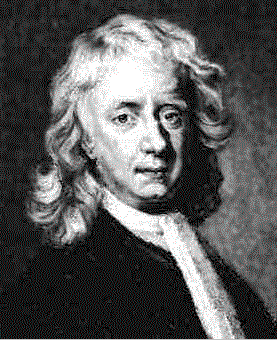
Newton's Laws of Motion

The motion of an aircraft through the air can be explained and described by physical principals discovered over 300 years ago by Sir Isaac Newton. Newton worked in many areas of mathematics and physics. He developed the theories of gravitation in 1666, when he was only 23 years old. Some twenty years later, in 1686, he presented his three laws of motion in the "Principia Mathematica Philosophiae Naturalis." The laws are shown above, and the application of these laws to aerodynamics are given on separate slides.

Newton's first law states that every object will remain at rest or in uniform motion in a straight line unless compelled to change its state by the action of an external force. This is normally taken as the definition of inertia. The key point here is that if there is no net force acting on an object (if all the external forces cancel each other out) then the object will maintain a constant velocity. If that velocity is zero, then the object remains at rest. If an external force is applied, the velocity will change because of the force.

The second law explains how the velocity of an object changes when it is subjected to an external force. The law defines a force to be equal to change in momentum (mass times velocity) per change in time. Newton also developed the calculus of mathematics, and the "changes" expressed in the second law are most accurately defined in differential forms. (Calculus can also be used to determine the velocity and location variations experienced by an object subjected to an external force.) For an object with a constant mass m, the second law states that the force F is the product of an object's mass and its acceleration a:

F = m * a

For an external applied force, the change in velocity depends on the mass of the object. A force will cause a change in velocity; and likewise, a change in velocity will generate a force. The equation works both ways.

The third law states that for every action (force) in nature there is an equal and opposite reaction. In other words, if object A exerts a force on object B, then object B also exerts an equal force on object A. Notice that the forces are exerted on different objects. The third law can be used to explain the generation of lift by a wing and the production of thrust by a jet engine.

Source: NASA

Monday, May 5, 2008

U.S. Hispanic Population Surpasses 45 Million


Now 15 Percent of Total
The nation’s Hispanic population increased 1.4 million to reach 45.5 million on July 1, 2007, or 15.1 percent of the estimated total U.S. population of 301.6 million.
National and state estimates by race, Hispanic origin, sex and age released today by the U.S. Census Bureau also show that the Hispanic population exceeded 500,000 in 16 states.
Hispanics remained the largest minority group, with blacks (single race or multiracial) second at 40.7 million in 2007. The black population exceeded 500,000 in 20 states. Blacks were the largest minority group in 24 states, compared with 20 states in which Hispanics were the largest minority group
Blacks were followed by Asians, who totaled 15.2 million; American Indians and Alaska Natives, who totaled 4.5 million; and Native Hawaiians and Other Pacific Islanders, with 1 million. The population of whites (single race and not of Hispanic origin) totaled 199.1 million.
With a 3.3 percent increase between July 1, 2006, and July 1, 2007, Hispanics were the fastest-growing minority group. Asians were the second fastest-growing minority group, with a 2.9 percent population increase during the period. The white population grew by 0.3 percent during the one-year period.
Overall, the nation’s minority population reached 102.5 million in 2007 — 34 percent of the total. California had a minority population of 20.9 million — 20 percent of the nation’s total, Texas had a minority population of 12.5 million — 12 percent of the U.S. total.
Four states and the District of Columbia were “majority-minority” (i.e., more than 50 percent of their population is made up of people other than single-race non-Hispanic whites). Hawaii led the nation with a population that was 75 percent minority in 2007, followed by the District of Columbia (68 percent), New Mexico (58 percent), California (57 percent) and Texas (52 percent). Next in line, though not majority-minority, were Nevada, Maryland and Georgia, each with a minority population of 42 percent.

Sunday, May 4, 2008

Cinco de Mayo (May 5)

On May 5, Los Angeles, California is alive with color, laughter and dancing. More than 500,000 Mexicans and Americans of Mexican origin are celebrating Cinco de Mayo or the "Fifth of May." It is an occasion which Mexicans and Americans share to emphasize the friendship between their two countries.

The holiday originated with a surprising battle. In 1861, France, England and Spain sent ships to Mexico to settle a debt. Within a few months, an agreement was reached and the British and Spanish navy set sail toward home. But the French ships, by order of Napoleon III, began an attack. On May 5, 1862, 6000 soldiers under the commander of the French forces tried to capture the forts of Loreto and Guadalupe in Puebla de Los Angeles, Mexico. Two thousand Mexican men, led by General Ignazio Zaragoza, fought back hard and held the fort. Although smaller in number, the Mexican army won this battle but they did not win the war. The French conquered the country, and in 1864, a European emperor was put on the Mexican throne. Three years later, after a reign filled with problems, the emperor was deposed and killed.

Even during the short period of French rule, the Mexicans celebrated Cinco de Mayo. They changed the name of the town where the French were defeated to Puebla de Zaragoza.

Interesting Numbers:

28.3 million
Number of U.S. residents of Mexican origin in 2006. These residents constituted 9 percent of the nation’s total population and 64 percent of the Hispanic population.

17.86 million
Number of people of Mexican origin who lived either in California (10.84 million) or Texas (7.02 million). People of Mexican origin made up more than one-quarter of the residents of these two states. (The unrounded total for California and Texas combined is 17,866,191.)

25.7
Median age of people in the United States of Mexican descent. This compares with 36.4 years for the population as a whole.

630,000
Number of Mexican-Americans who are U.S. military veterans.

Source: Foreign Trade Statistics <http://www.census.gov/foreign-trade/www/>

Business is Good

Thinking of starting a business? Not sure which industry to go into? With all the economic talk of recession, slow downs, gas prices and foreclosures, it might be good to see how some of the companies we've heard of are doing.

Take a look at this special report by Forbes called The World's Biggest Companies. According to the report, the global 2000 companies now account for $30 trillion in revenues, $2.4 trillion in profits, $119 trillion in assets and $39 trillion in market value. Around the world, 72 million people work for these companies. Below is a partial list of the companies ranked by profits.

Rank Company Country Industry Sales ($bil) Profits ($bil) Assets ($bil) Market Value ($bil)
16 Wal-Mart Stores United States Retailing 378.80 12.73 163.38 198.60
5 ExxonMobil United States Oil & Gas Operations 358.60 40.61 242.08 465.51
6 Royal Dutch Shell Netherlands Oil & Gas Operations 355.78 31.33 266.22 221.09
7 BP United Kingdom Oil & Gas Operations 281.03 20.60 236.08 204.94
17 Chevron United States Oil & Gas Operations 203.97 18.69 148.79 179.97
8 Toyota Motor Japan Consumer Durables 203.80 13.99 276.38 175.08
15 Total France Oil & Gas Operations 199.74 19.24 165.75 181.80
9 ING Group Netherlands Insurance 197.93 12.65 1,932.15 75.78
573 General Motors United States Consumer Durables 181.12 -38.73 148.88 13.18
2 General Electric United States Conglomerates 172.74 22.21 795.34 330.93
532 Ford Motor United States Consumer Durables 172.46 -2.72 279.26 14.41
22 ConocoPhillips United States Oil & Gas Operations 171.50 11.89 177.76 129.15
24 Citigroup United States Banking 159.23 3.62 2,187.63 123.44
20 AXA Group France Insurance 151.70 7.75 1,064.67 70.33
36 Volkswagen Group Germany Consumer Durables 149.00 5.64 210.88 90.23
1 HSBC Holdings United Kingdom Banking 146.50 19.13 2,348.98 180.81
38 Daimler Germany Consumer Durables 145.11 5.82 199.77 85.16
87 Dexia Belgium Banking 140.78 3.47 889.98 28.04
14 Allianz Germany Insurance 139.12 10.90 1,547.48 80.30
52 Sinopec-China Petroleum China Oil & Gas Operations 133.79 6.90 77.44 186.38
47 Fortis Netherlands Diversified Financials 121.19 5.46 1,020.98 49.04
28 ENI Italy Oil & Gas Operations 119.27 13.70 128.15 127.38
3 Bank of America United States Banking 119.19 14.98 1,715.75 176.53
12 AT&T United States Telecommunications Services 118.93 11.95 275.64 210.22
10 Berkshire Hathaway United States Diversified Financials 118.25 13.21 273.16 216.65
386 UBS Switzerland Diversified Financials 116.98 -3.65 2,019.17 68.26
4 JPMorgan Chase United States Banking 116.35 15.37 1,562.15 136.88
13 BNP Paribas France Banking 116.16 10.71 2,494.41 81.90
98 Carrefour Group France Food Markets 112.40 3.15 75.73 49.95
18 American Intl Group United States Insurance 110.06 6.20 1,060.51 118.20
10 Royal Bank of Scotland United Kingdom Banking 108.45 14.62 3,807.51 76.64
53 Hewlett-Packard United States Technology Hardware & Equip 107.67 7.85 88.57 122.04
38 ArcelorMittal Luxembourg Materials 105.22 10.37 133.65 108.82
102 Société Générale Group France Banking 103.44 1.30 1,573.13 62.93
50 Siemens Germany Conglomerates 103.20 5.42 126.72 118.47
61 Generali Group Italy Insurance 102.16 3.17 486.43 60.79
45 Crédit Agricole France Banking 101.59 6.49 1,662.60 45.73
44 HBOS United Kingdom Banking 100.32 8.10 1,336.17 44.84
326 McKesson United States Drugs & Biotechnology 99.64 0.94 25.37 16.97
37 IBM United States Software & Services 98.79 10.42 120.43 157.62
32 Deutsche Bank Germany Diversified Financials 95.50 7.45 1,485.58 56.27
45 Nestlé Switzerland Food Drink & Tobacco 94.76 9.38 99.06 188.11
144 Valero Energy United States Oil & Gas Operations 94.53 5.23 41.86 31.80
68 Honda Motor Japan Consumer Durables 94.35 5.04 101.82 56.82
27 E.ON Germany Utilities 94.04 9.86 200.84 126.22
48 Verizon Communications United States Telecommunications Services 93.47 5.65 186.96 104.27
59 Samsung Electronics South Korea Semiconductors 92.26 8.56 87.49 87.84
66 Nippon Telegraph & Tel Japan Telecommunications Services 91.57 4.06 149.71 60.27
172 Deutsche Telekom Germany Telecommunications Services 91.26 0.83 166.50 83.19
282 Cardinal Health United States Drugs & Biotechnology 89.39 1.55 23.47 21.09
96 Nissan Motor Japan Consumer Durables 89.09 3.92 104.20 37.90
60 StatoilHydro Norway Oil & Gas Operations 89.00 7.52 89.16 98.36
30 PetroChina China Oil & Gas Operations 88.24 18.21 111.70 546.14
23 Goldman Sachs Group United States Diversified Financials 87.97 11.60 1,119.80 67.16

See the full list here
Source: Forbes.com

Thursday, May 1, 2008

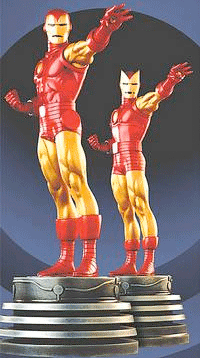
Iron Man


Six months after his first appearance, Iron Man, along with Thor, Ant Man, The Wasp, and The Hulk, became a corner stone member of The Avengers, Marvel's answer to DC's Justice League of America. On top of the usual adventuring and criminal bashing, he served that group as its first important source of funding. He has stayed with The Avengers and its offshoots, off-and-on, ever since. He has also been affiliated with S.H.I.E.L.D., Marvel's late-'60s, superhero-oriented U.N.C.L.E. knock-off.

Anthony Stark, son of industrialist Howard Stark, demonstrated his mechanical aptitude and inventive genius at a very early age, enrolling in college electrical engineering program at the Massachusetts Institute of Technology at the age of 15. When he was 21, he inherited his father's business, Stark Industries, and within a few years turned it into a multimillion-dollar industry complex whose chief contracts were for weaponry and munitions for the U.S. government.

Without his armor Tony Stark possesses the normal strength of a normal human man his age, height, and build who engages in moderate regular exercise. Iron man is possessed with great strength and supernatural powers. He boasts of a virtual invulnerability and a complete array of arms and ammunitions. Iron Man is a playable character in Marvel Ultimate Alliance. His costumes include his New Avenger armor, his Classic armor, the War Machine armor, and his Ultimate armor.